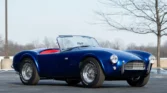
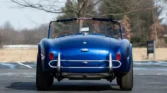
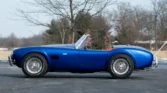
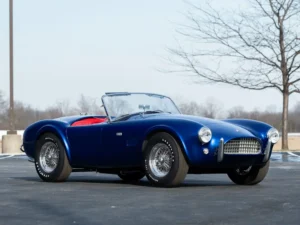
Attractive, lightweight, and proven, the AC Ace could, by Shelby’s thinking, be turned into a successful production racer by replacing its aging six-cylinder engine with a powerful, deep-breathing V-8. In September 1961, Shelby wrote Charles Hurlock, of AC Cars, to propose a hybrid car using the AC sports car body and chassis. “I’m interested,” wrote Hurlock, “if a suitable V-8 could be found.” Shelby moved quickly when Ray Brock, editor of Hot Rod magazine, told him of Ford’s…
Attractive, lightweight, and proven, the AC Ace could, by Shelby’s thinking, be turned into a successful production racer by replacing its aging six-cylinder engine with a powerful, deep-breathing V-8. In September 1961, Shelby wrote Charles Hurlock, of AC Cars, to propose a hybrid car using the AC sports car body and chassis. “I’m interested,” wrote Hurlock, “if a suitable V-8 could be found.” Shelby moved quickly when Ray Brock, editor of Hot Rod magazine, told him of Ford’s new, lightweight small-block V-8. Soon after, Shelby had an early 221-cubic-inch example installed in a stock AC Ace, and it was found that the V-8 weighed just slightly more than the six-cylinder Bristol.
Sporting a four-speed manual gearbox, the prototype, chassis CSX 2000, weighed in at just 2,100 pounds and was campaigned across the United States. Shelby American could barely meet demand for the brawny little racecar. By 1963 Shelby upped the ante, switching to a rack-and-pinion steering system—and, most notably, adopting the 289-cubic-inch Ford motor with 271 horsepower. The Shelby 289 Cobra was able to accelerate from 0-60 mph in just 5.8 seconds, with a top speed of 130 mph. The superb power-to-weight ratio enabled the newcomer to take 7th place in the 1963 24 Hours of Le Mans, and Dan Gurney went on to be the first US driver to win an FIA race in an American car at the Bridgehampton 500 KM in September of the same year. The following year at Le Mans, the Shelby Cobra won 4th place overall and 1st in the GT class.